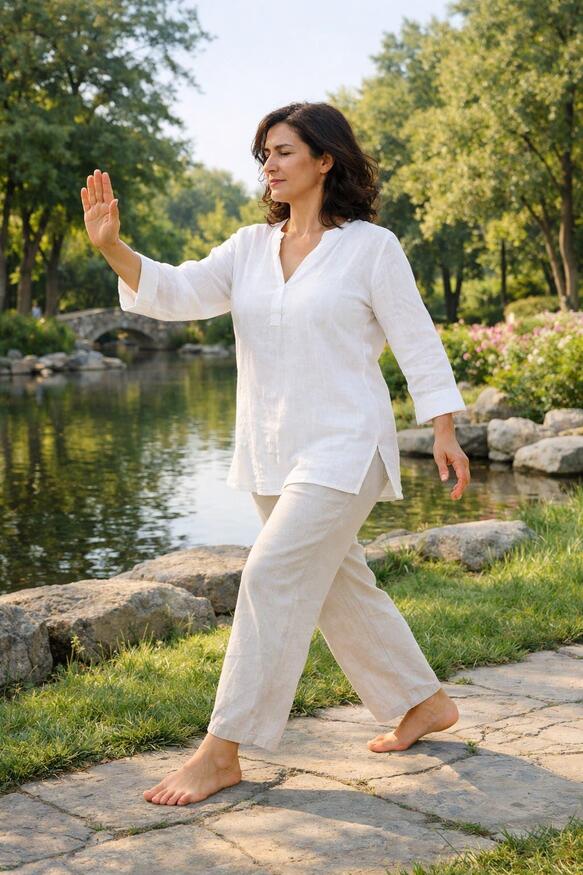
Tai Chi walking is not “walking slowly for no reason.” It is a structured weight-transfer practice that trains balance, posture, coordination, and attention.
How Tai Chi walking differs from regular walking
Regular walking
Tai Chi walking
Natural pace
Intentionally slow pace
Stride length varies
Short, controlled steps
Momentum often carries the body forward
Weight transfer is consciously managed
Attention may wander
Attention is directed to posture, feet, and breathing
Fitness goal is often distance or time
Primary goal is balance, coordination, and body awareness
Potential benefits
Research on Tai Chi generally—not only walking drills, but Tai Chi practice as a whole—has found benefits in several areas that are directly relevant to walking function:
Balance and fall prevention: Tai Chi has been associated with improved balance performance and reduced fall risk in older adults in multiple systematic reviews and clinical guidelines.
Mobility and gait: Slow weight-shifting practice can improve gait confidence, turning control, and movement coordination. Tai Chi-based interventions have shown improvements in functional mobility measures in older adults.
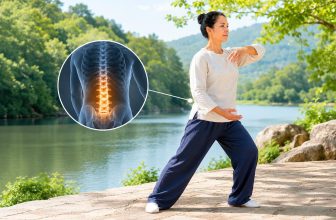
Postural control: The practice encourages an upright trunk, relaxed shoulders, and coordinated lower-limb movement, which may help counter stiff, hurried walking patterns.
Stress regulation and mindful attention: Tai Chi is commonly described as a mind-body exercise that combines movement, breathing, and focused attention. Many practitioners report a calmer, more centered walking experience.
What the evidence does and does not say
The strongest evidence is for Tai Chi programs overall, not specifically for “Tai Chi walking” as a standalone branded method. The benefits below are best interpreted as benefits plausibly obtained through Tai Chi-style walking practice that uses the same balance, weight-shift, posture, and attention principles studied in Tai Chi interventions.
A beginner-friendly Tai Chi walking technique
This version is intentionally simple and suitable for most healthy adults.
10-minute Tai Chi walking routine
Set your posture (1 minute):
Stand with feet hip-width apart.
Let the shoulders soften.
Lengthen through the crown of the head without lifting the chin.
Breathe naturally.
Shift your weight (2 minutes):
Transfer 70–80% of your weight to the left foot while the right foot stays lightly connected to the floor.
Return to center, then shift to the right foot.
Move slowly enough that you could stop at any moment without wobbling.
Add a step (3 minutes):
Shift weight onto the standing leg.
Lift the free foot only a small amount.
Place the heel lightly, then let the sole settle.
Transfer weight gradually onto the stepping foot.
Bring the back foot forward a short distance.
Coordinate breathing (2 minutes):
Inhale as you prepare or shift.
Exhale as the weight settles onto the stepping foot.
Do not force the breath rhythm; comfort is more important than precision.
Finish with stillness (2 minutes):
Stand quietly.
Notice whether the feet feel more evenly connected to the floor.
Take two or three relaxed breaths before walking normally.
Common mistakes to avoid
Overstriding: Long steps make controlled weight transfer harder.
Leaning the torso forward: Keep the trunk relatively upright and let the legs move beneath you.
Locking the knees: Maintain a soft bend.
Holding the breath: Breathe continuously.
Rushing the weight shift: The shift is the exercise; the step is secondary.
Who may benefit most?
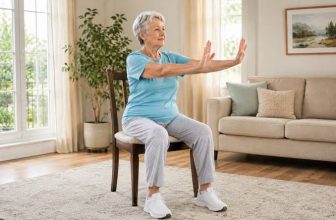
Older adults working on balance confidence.
People returning to exercise after a sedentary period.
Individuals who find conventional exercise intimidating and prefer a low-impact practice.
Anyone interested in combining walking with mindfulness and posture training.
Safety note
If you have severe balance impairment, recent falls, a neurologic condition, major joint instability, or are recovering from surgery, consult a clinician or physical therapist before beginning. Start near a wall, railing, or sturdy support if needed. This article is educational and not a substitute for medical advice.