Tai Chi “Grasp Bird’s Tail” vs. the Push-Up: Strength, Flow, and Functional Power
If you’re looking to understand how traditional Tai Chi movements compare to modern strength exercises, a great place to start is with “Grasp Bird’s Tail” and the classic push-up. At first glance, they seem completely different—but biomechanically, they share surprising similarities.
This guide breaks down both movements for fitness, functionality, and friendly insight, while helping readers connect internal topics like Tai Chi strength, balance, and mindful movement.
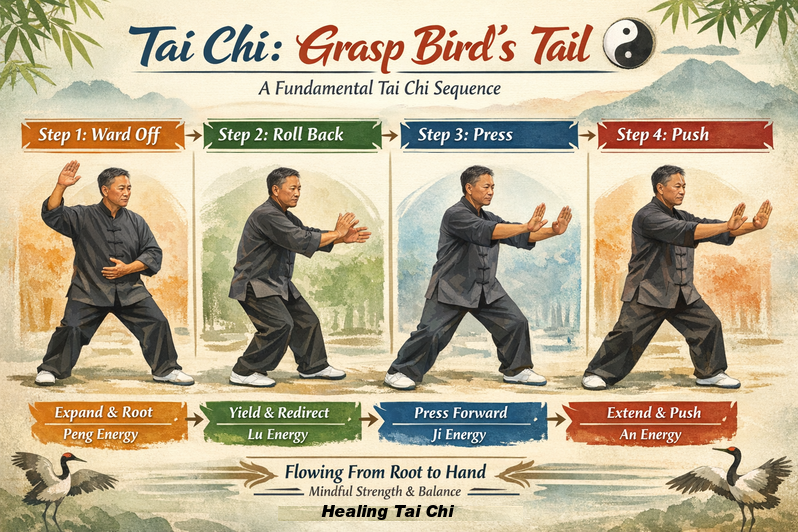
What Is “Grasp Bird’s Tail” in Tai Chi?
“Grasp Bird’s Tail” is one of the most fundamental sequences in Tai Chi, especially in Yang-style forms. It consists of four key energies:
- Ward Off (Peng) – expanding, structural strength
- Roll Back (Lu) – yielding and redirecting force
- Press (Ji) – forward energy using both arms
- Push (An) – controlled forward extension
This flowing sequence trains coordination, joint stability, and whole-body integration.
What Is a Push-Up?
The push-up is a foundational bodyweight exercise used in strength training. It primarily targets:
- Chest (pectorals)
- Shoulders (deltoids)
- Triceps
- Core stabilizers
It’s a linear pushing movement, focused on building upper-body strength and endurance.
Key Similarities Between Grasp Bird’s Tail and Push-Ups
1. Pressing Mechanics
The “Press” (Ji) phase in Grasp Bird’s Tail closely resembles the pushing action in a push-up.
- Both involve forward force generation
- Both require shoulder stabilization
- Both engage the chest and arms
-
2. Core Engagement
A proper push-up demands a tight, stable core. Similarly, Tai Chi requires:
- Continuous core activation
- Balance between upper and lower body
- Controlled breathing with movement
-
3. Joint Integrity and Alignment
Both movements emphasize:
- Proper wrist alignment
- Shoulder stability
- Spine neutrality
However, Tai Chi places greater emphasis on relaxed structure, while push-ups rely on muscular tension.
Key Differences: Where Tai Chi Stands Apart
1. Speed and Intensity
- Push-ups: Fast, repetitive, strength-focused
- Grasp Bird’s Tail: slow, controlled, mindful
Tai Chi builds functional strength over time, rather than immediate muscle fatigue.
2. Whole-Body Integration
Push-ups are primarily upper-body dominant.
Grasp Bird’s Tail, however, involves:
- Weight shifting
- Hip rotation
- Ground force transfer from feet to hands
This creates full kinetic chain activation.
3. Energy vs. Muscle Focus
- Push-ups = muscular strength
- Tai Chi = internal energy (Qi) + structure + coordination
Tai Chi teaches you how to use less force more efficiently, which is critical for longevity and injury prevention.
Which Is Better for You?
Choose Push-Ups If You Want:
- Faster muscle building
- Upper body strength gains
- Simple, measurable progress
Choose Grasp Bird’s Tail If You Want:
- Joint-friendly strength
- Better balance and coordination
- Mind-body connection
- Long-term functional fitness
👉 Best approach: Combine both for optimal results.
Practical Integration: Tai Chi + Push-Up Routine
Try this simple pairing:
- Perform 5–10 push-ups
- Immediately follow with Grasp Bird’s Tail (slow, 3–5 repetitions)
- Focus on:
- Relaxation after effort
- Breathing control
- Smooth transitions
This contrast improves both strength and recovery. While the push-up builds raw strength, Tai Chi’s Grasp Bird’s Tail develops refined strength—the kind that improves balance, coordination, and longevity.Instead of choosing one over the other, the smartest strategy is integration. Tai Chi fills the gaps that traditional strength training often misses.