Discover Tai Chi for Lower Back Pain: 5 Gentle Exercises for Relief
 Healing Taichi
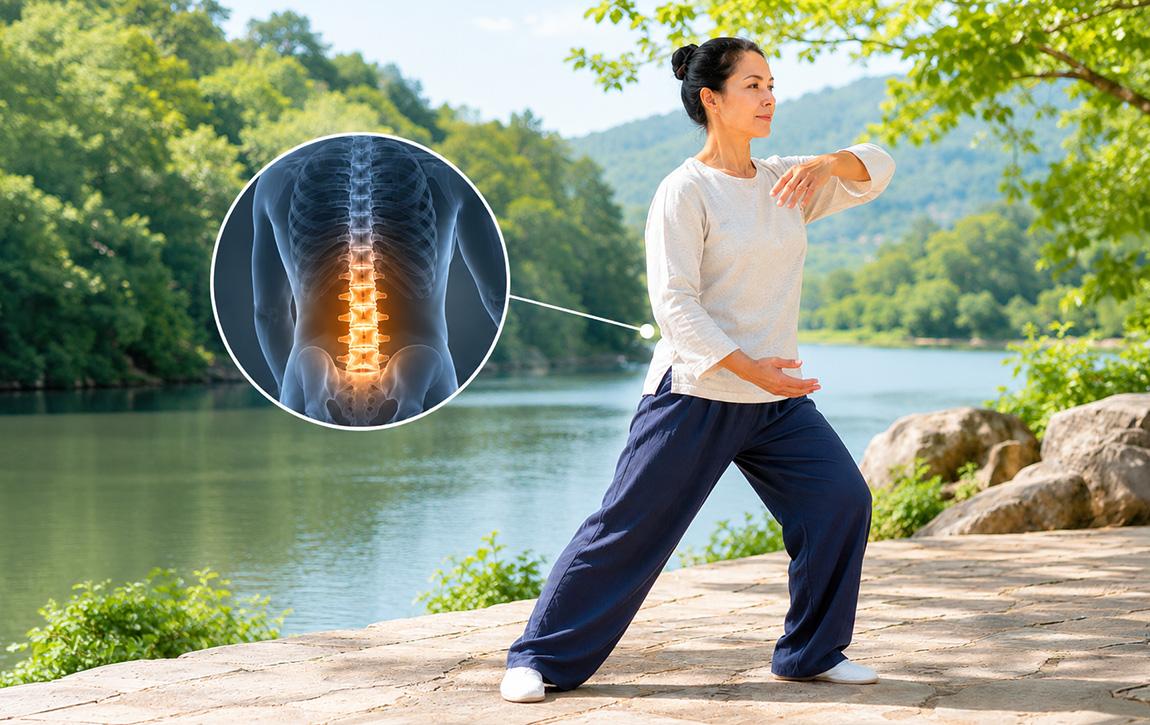
Can Tai Chi Help Lower Back Pain?
Yes. Research increasingly supports Tai Chi as a useful low-impact exercise option for people with chronic low back pain.
Lower back pain is extremely common and is a major cause of disability worldwide. The World Health Organization reports that approximately 619 million people experienced low back pain in 2020, with the number expected to rise substantially as populations age.
Tai Chi combines slow, controlled movements with weight shifting, postural control, breathing and focused attention. Unlike high-impact exercise, Tai Chi can be performed at a relatively gentle intensity and can be modified for different abilities.
Importantly, Tai Chi should be viewed as one component of a broader approach to back-pain management, rather than a guaranteed cure.
The WHO’s 2023 guideline for chronic primary low back pain recommends exercise programs among the evidence-based non-surgical approaches that can be considered for adults with chronic low back pain.
5 Tai Chi Exercises for Lower Back Pain
The following movements emphasize gentle weight transfer, upright posture, hip movement and controlled breathing.
1. Tai Chi Walking
Tai Chi walking is one of the simplest places to begin.
How to do it:
- Stand upright with your feet comfortable and knees relaxed.
- Slowly shift your weight onto one leg.
- Move the opposite foot forward.
- Place the foot gently on the floor.
- Gradually transfer your weight onto the forward leg.
- Repeat slowly.
Keep your torso upright rather than leaning backward or forward.
Why it may help: Tai Chi walking trains controlled weight transfer, balance and coordination while encouraging the hips and legs to contribute to movement rather than relying exclusively on the lower back.
2. Cloud Hands
Cloud Hands is a classic Tai Chi movement involving gentle side-to-side weight transfer and coordinated arm movement.
How to do it:
- Stand with your feet comfortably apart.
- Bend your knees slightly.
- Shift your weight slowly toward one leg.
- Move your arms in a relaxed circular pattern.
- Transfer your weight toward the opposite leg.
- Continue slowly from side to side.
Don’t force your torso to rotate. The movement should remain comfortable.
Back-pain tip: Think about moving from your hips and legs, rather than twisting aggressively through your lumbar spine.
3. Opening and Closing
This is an excellent beginner movement and can serve as a warm-up.
How to do it:
- Stand comfortably.
- Keep your knees slightly relaxed.
- Slowly raise your hands as you inhale.
- Gently lower your hands as you exhale.
- Keep your shoulders relaxed.
- Repeat several times.
The goal isn’t to stretch as far as possible. Instead, concentrate on relaxed breathing and smooth movement.
4. Gentle Weight Shifting
Weight shifting is fundamental to Tai Chi and can be particularly useful for people who need to improve balance and movement control.
Practice:
- Stand with your feet comfortably apart.
- Shift your weight slowly to the right.
- Return toward center.
- Shift slowly to the left.
- Keep your spine comfortably upright.
- Repeat for 30–60 seconds.
You can perform this while holding a sturdy chair or countertop if you need additional support.
5. Modified Grasp Bird’s Tail
Grasp Bird’s Tail combines several fundamental Tai Chi actions.
For someone with lower back pain, use a small range of motion.
Avoid forcing:
- deep forward bending
- extreme spinal rotation
- large twisting movements
- uncomfortable stances
Concentrate instead on smooth weight transfer and relaxed movement.
If this movement aggravates your symptoms, leave it out and return to walking, opening and closing, or gentle weight shifting.
A Simple 5-Minute Tai Chi Routine for Lower Back Pain
You don’t need a 30- or 60-minute workout to begin.
Try:
| Time | Exercise |
|---|---|
| 1 minute | Opening & Closing |
| 2 minutes | Tai Chi Walking |
| 1 minute | Cloud Hands |
| 1 minute | Gentle Weight Shifting |
Finish with several slow breaths.
As your tolerance improves, gradually increase the duration.
Consistency is more important than intensity.
What Does the Scientific Research Say?
The evidence has become considerably stronger in recent years.
A 2026 systematic review and meta-analysis examined 14 randomized controlled trials involving 960 adults with chronic low back pain. Compared with control conditions, Tai Chi was associated with reduced pain intensity and improvements in disability. The review rated the evidence for pain reduction as moderate certainty, although certainty for many disability outcomes was lower and there was substantial variation between studies.
Another 2025 systematic review and meta-analysis examined eight randomized controlled trials involving 729 adults. It found that Tai Chi and Qigong were associated with significant reductions in both pain and disability, while also emphasizing substantial heterogeneity between studies.
A 2024 meta-analysis of 10 randomized controlled trials involving 886 participants likewise reported significant improvements in pain, disability and quality-of-life measures among people with chronic low back pain who practiced Tai Chi.
Earlier evidence also reached a similar conclusion. A systematic review and meta-analysis published in Medicine found that Tai Chi alone or combined with conventional physical therapy could reduce pain and improve functional disability in people with low back pain.
What does this mean?
The research does not mean Tai Chi will eliminate everyone’s back pain.
Instead, the evidence suggests that Tai Chi can be a reasonable low-impact exercise and self-management option, particularly when practiced consistently and appropriately.
Why Might Tai Chi Help the Lower Back?
Several characteristics of Tai Chi may explain its potential benefits.
1. Controlled movement
Tai Chi requires slow, deliberate movement rather than sudden loading of the spine.
2. Weight transfer
Repeated weight shifting trains the legs, hips and balance system.
3. Postural awareness
Practitioners learn to maintain a more organized, relaxed posture while moving.
4. Muscle engagement
Tai Chi isn’t simply “standing and waving your arms.” Maintaining the stance and controlling movement requires work from the legs and trunk.
5. Relaxation and breathing
The combination of movement, breathing and focused attention may also help reduce stress and muscle tension.
Watch a Gentle Tai Chi Routine for Back Pain
One useful beginner-oriented video is:
“15-min Tai Chi Flow for Back Pain | Gentle Movements to Ease Tension & Improve Flexibility” from Begin with Breath Tai Chi / Dr. Adam Potts, PT. The video describes a gentle routine intended for people experiencing back pain or stiffness and includes a medical disclaimer.
Tip: Don’t attempt to match the instructor’s range of motion. Your comfortable range is the appropriate range.
Tai Chi for Seniors With Lower Back Pain
Tai Chi can be particularly attractive for older adults because it is low impact and adaptable.
However, people with significant balance limitations may want to begin with:
- a chair-supported routine
- seated Tai Chi
- a qualified instructor
- a physical therapist’s guidance
A chair can also be positioned nearby for balance support during standing exercises.
The goal isn’t to perform Tai Chi perfectly. The goal is to develop safe, controlled movement that you can perform consistently.
Safety: When You Should Not Exercise Through Back Pain
Tai Chi should feel gentle—not painful.
Stop the exercise if you experience:
- sharp or increasing back pain
- pain traveling down the leg
- new numbness or tingling
- significant weakness
- dizziness
- symptoms that progressively worsen
Seek medical evaluation for severe, persistent or unexplained back pain, particularly following an injury.
Tai Chi should complement—not replace—appropriate medical care.
The Bottom Line
Tai Chi may be an effective, gentle exercise option for people with chronic lower back pain.
Current systematic reviews and meta-analyses report improvements in pain and, in many studies, disability and physical function. The strongest evidence supports Tai Chi as part of a broader approach to managing chronic low back pain rather than as a stand-alone cure.
For beginners, start with Tai Chi walking, gentle weight shifting, Opening and Closing, and Cloud Hands. Keep movements slow, stay within a comfortable range, and gradually increase your practice.
A few minutes of gentle Tai Chi practiced consistently may be a better starting point than an intense workout that aggravates your back.
Recommended Resources & References
- World Health Organization — Chronic Low Back Pain Guideline — evidence-based guidance for non-surgical management.
- WHO — Low Back Pain Fact Sheet — global statistics and self-care information.
- 2026 Tai Chi Systematic Review & Meta-Analysis — PubMed — 14 RCTs and 960 participants.
- 2025 Tai Chi & Qigong Systematic Review — PubMed — eight RCTs and 729 participants.
- 2024 Tai Chi Meta-Analysis for Chronic Low Back Pain — PubMed — 10 RCTs and 886 participants.
- Tai Chi for Low Back Pain Systematic Review — PubMed
Medical disclaimer: This article is for educational purposes and is not a diagnosis or substitute for individualized medical advice. Anyone with significant, persistent, worsening, or unexplained back pain should consult an appropriately qualified healthcare professional.