Slow arm circles, a steady breath, and both feet resting on the floor: seated Tai Chi exercises offer a way to practice gentle, coordinated movement without standing or crossing a room. A chair can make the practice more accessible while still giving you room to work on control and body awareness.
You can adapt seated Tai Chi to your comfort, strength, and range of motion. The aim isn’t to copy every move or stretch as far as possible. A stable chair, small movements, and a short routine can help you get started at a pace that feels manageable.
Seated Tai Chi is a gentle movement practice, not a guaranteed treatment or a replacement for medical care. Research on standing Tai Chi does not automatically apply to seated versions, so it helps to check what each study actually examined.
Set Up for Seated Tai Chi Exercises Safely
A few small changes to your space and sitting position can make the movements easier to control. Take a moment to get settled before you begin.
Choose a stable chair and clear space
Use a firm chair without wheels, set on a level floor. Leave enough room for your arms to move in front of and beside you. If you need help getting into or out of the chair, ask someone to assist rather than rushing.
Sit tall without stiffening
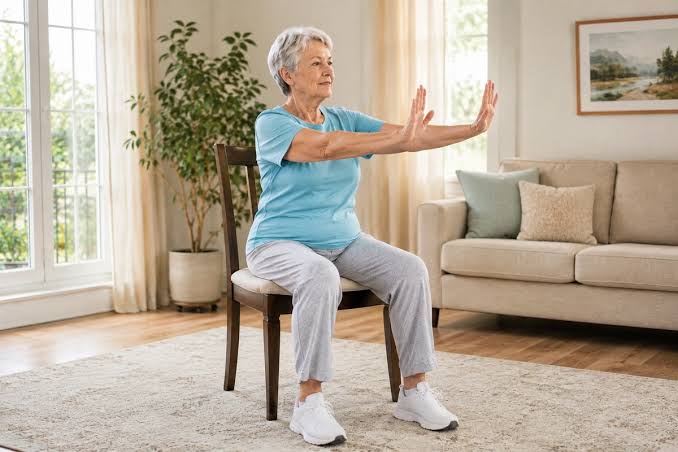
Sit toward the front or middle of the seat, with your feet supported on the floor or a firm footrest. Keep your knees comfortable and let your shoulders rest away from your ears. The NHS guide to sitting exercises also recommends a stable, non-wheeled chair and feet flat on the floor.
Check in with your body
Before moving, notice how you feel. If you have pain, dizziness, unusual breathlessness, or strong fatigue, pause and consider whether the practice is right for you that day. If a health condition, recent surgery, injury, or fall risk affects your movement, ask a clinician or physical therapist for personal guidance.
Learn Gentle Seated Tai Chi Exercises
Move slowly enough to stay in control, and keep each movement within a comfortable range. There’s no need to hold your breath or force a stretch.
Start with breathing and shoulder rolls
Settle into the chair and let your breath follow its natural pace. As you breathe, lift your shoulders slightly, roll them back, and let them drop; make the circles small and easy. Reverse direction if it feels good, and stop if the motion causes pain.
Raise and open your arms
With your hands resting near your thighs, slowly raise your arms in front of you, only as high as feels comfortable. Lower them with control, then try opening your arms slightly to the sides before bringing them back in. If your shoulders feel sore, use a smaller range or keep your elbows bent.
Try seated “cloud hands”
Hold your hands in front of your body, palms relaxed. Move them gently from side to side, letting one hand rise as the other lowers while your torso stays mostly upright. The name and form can vary by teacher, so use a qualified instructor or reliable demonstration if you want to learn a specific style.
Build Leg and Trunk Mobility While Seated
Your lower body can join the practice without leaving the chair. Keep your feet near the floor and stay within a range that feels steady.
Add heel lifts and toe lifts
With both feet planted, raise your heels while the balls of your feet stay down. Lower them, then lift your toes while keeping your heels on the floor. Alternate at an easy pace, holding the sides of the chair or pausing when you need a rest.
Shift your weight gently
Keep both feet supported and move your upper body a little to one side, then return to center and shift the other way. Stay upright and avoid leaning far enough to feel unstable. If you feel off-balance, make the shift smaller or skip it.
Pair arm and foot movements
Once the individual moves feel familiar, you can combine them. For example, open your arms as you lift your heels, then lower both with control. Coordination is optional; practicing the arm and foot movements separately is useful, too.
Create a Short Seated Tai Chi Routine
A repeatable practice doesn’t need to feel like a workout. Choose a few movements and leave room to pause.
Follow a simple sequence
Begin with a few calm breaths, then do shoulder rolls and arm raises. Add cloud hands, heel or toe lifts, and a few small weight shifts if they feel comfortable. Finish by resting your hands on your thighs and taking a few easy breaths.
Adapt the practice to your energy
On a low-energy day, try only the breathing and shoulder movements. Take breaks, reduce the range, or stop early if you feel tired or uncomfortable. There’s no need to push through pain to complete a routine.
Learn from a reliable teacher
A Tai Chi teacher can help you refine the movements and offer changes for your needs. You might also ask a rehabilitation professional about safe options, or look for an established community program. Check an instructor’s training and experience, since Tai Chi teaching has no single national licensing standard.
Understand the Benefits and Limits of Seated Tai Chi
People may enjoy seated Tai Chi for its slow movement, focus on body awareness, and calming pace. What you gain will depend on your health, the movements you practice, and how your body responds.
Keep possible benefits in perspective
The National Center for Complementary and Integrative Health (NCCIH) reports that research suggests Tai Chi may help with some outcomes, including balance in older adults and certain types of pain. Much of that research examines Tai Chi generally, not every chair-based adaptation.
There is some research on seated practice. In a study reported by the American Heart Association, 160 people recovering from a recent stroke were assigned to a modified seated Tai Chi program or standard rehabilitation exercises. The seated program group showed gains in some measured areas after 12 weeks, but the study focused on stroke recovery and does not prove the same results for everyone.
Check what research actually studied
When you read about a health benefit, look for whether the study tested seated or standing Tai Chi, who took part, and which outcomes researchers measured. Results from standing routines shouldn’t be treated as proof that a seated version has the same effects. For broader evidence and safety details, NCCIH’s Tai Chi resource summarizes research and notes where more study is needed.
Know when to ask for help
Talk with a clinician or physical therapist before starting if you have significant balance concerns, pain, medical movement limits, or recent surgery or injury. Seated Tai Chi isn’t a substitute for prescribed treatment or rehabilitation. Stop if symptoms arise, and seek advice if you’re unsure which movements are suitable.
Conclusion
A steady chair, supported feet, and small, relaxed movements are a good starting point for seated Tai Chi exercises. Begin with breathing, shoulder rolls, and one or two arm or foot movements; build a routine only as it feels comfortable. Try a few gentle moves at your next available moment, and ask a health professional for help if your needs call for a more tailored approach.