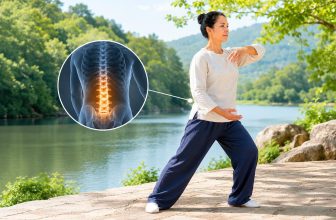
The 70% Rule in Tai Chi Walking is a practical guideline used in Tai Chi and Qigong to control weight distribution, balance, and joint safety during slow, mindful stepping. It’s essentially Tai Chi without the arm forms—pure lower-body mechanics and awareness.
What the 70% Rule Means
At any point in Tai Chi walking:
~70% of your body weight is placed on the front (loaded) leg
~30% remains on the rear (empty) leg
This creates a stable but mobile stance—rooted without being stiff.
How to Apply It Step-by-Step
Begin in a neutral stance Weight is roughly 50/50 before moving.
Shift weight deliberately Slowly transfer weight forward until the front leg carries about 70%.
Keep the rear leg “alive” The back foot stays grounded but light—ready to move.
Step only after the weight shift The stepping foot should feel almost empty before it lifts.
Why Tai Chi Uses 70% (Not 100%)
Protects the knees by avoiding full lock-in
Improves balance by maintaining a safety margin
Enhances sensitivity (listening energy / ting jin)
Allows instant direction change without loss of structure
Many classical Tai Chi forms alternate between 70/30 and 30/70, rarely committing to 100% unless momentarily issuing force.
Common Mistakes
Leaning the torso forward instead of shifting from the hips
Locking the front knee
Lifting the rear heel too early
Rushing the weight transfer
Simple Practice Drill
Walk a straight line slowly
Pause briefly at each step and mentally check: Is my stepping foot empty?
Keep the spine upright and pelvis relaxed
Move as if your head is suspended from above
Health & Rehabilitation Context
For practitioners using Tai Chi walking for:
Blood pressure control
Balance training
Joint rehabilitation
Core idea
At most points in Tai Chi walking, about 70% of your body weight is placed on the front (or working) leg, while about 30% remains on the rear (supporting) leg. The key point is that you never commit 100% of your weight suddenly.
How it’s applied in Tai Chi walking
Step forward lightly The foot touches the ground with minimal weight first (toe or heel depending on style).
Shift weight gradually Transfer weight until you reach ~70% on the front leg, not all the way.
Rear leg remains alive The back leg stays bent and engaged, never straight or empty.
Knees track correctly Front knee aligns with the toes; it does not push past them excessively.
Common variations
70/30 – neutral walking and most form practice
60/40 – higher stance, rehab, or beginners
80/20 – advanced rooting drills (used briefly, not constantly)
Traditional teachers emphasize that percentages are teaching tools, not rigid numbers. The real goal is continuous readiness.
Simple self-check
If you feel grounded yet mobile, you’re near the 70% sweet spot.
If someone gently pushes you and you can’t adjust without stiffening, you’re probably at 100%.
If you feel floating or unstable, you’re likely under 60%.